
 100% FREE ACCESS
12th Standard Syllabus & Materials
12th Standard
TN 12th Computer Applications மின்னணு தரவு பரிமாற்றம் Sample Question Papers Study Material - QB365 Set A
NEW12th Standard
TN 12th Computer Applications மின் - வணிக பாதுகாப்பு அமைப்புகள் Sample Question Papers Study Material - QB365 Set A
NEW12th Standard
TN 12th Computer Applications மின்னணு செலுத்தல் முறைகள் Sample Question Papers Study Material - QB365 Set A
NEW12th Standard
TN 12th Computer Applications மின் - வணிகம் Sample Question Papers Study Material - QB365 Set A
NEW12th Standard
TN 12th Computer Applications திறந்த மூல கருத்துருக்கள் Sample Question Papers Study Material - QB365 Set A
NEW12th Standard
TN 12th Computer Applications வலையமைப்பு வடமிடல் Sample Question Papers Study Material - QB365 Set A

Published on: 20/10/2025
Download Tamil Nadu 12th Standard Chemistry question papers, model tests, one-mark questions, important questions, and public exam papers in PDF format. Free study materials and answer keys for TN State Board students.
Questions + Answers key
Take MCQ Chemistry Test
1.
The polymer used in making blankets (artificial wool) is _______.
polystyrene
PAN
polyester
polythene
2.
Which of the following is a co-polymer?
Orlon
PVC
Teflon
PHBV
3.
4.
Which of the following is an analgesic?
Streptomycin
Chloromycetin
Asprin
Penicillin
5.
6.
The pyrimidine bases present in DNA are ______.
Cytosine and Adenine
Cytosine and Guanine
Cytosine and Thiamine
Cytosine and Uracil
7.
In aqueous solution of amino acids mostly exists in ______.
NH2-CH(R)-COOH
NH2-CH(R)-COO-
H3N+-CH(R)-COOH
H3N+-CH(R)-COO-
8.
In a protein, various amino acids linked together by ______.
Peptide bond
Dative bond
\(\alpha\) - Glycosidic bond
\(\beta\) - Glycosidic bond
9.
Which one given below is a non-reducing sugar?
Glucose
Sucrose
maltose
Lactose
10.
Which one of the following rotates the plane polarized light towards left?
D(+) Glucose
L(+) Glucose
D(-) Fructose
D(+) Galactose
11.
Which of the following amines does not undergo acetylation?
t – butylamine
ethylamine
diethylamine
triethylamine
12.
Nitrobenzene on reaction with Con HNO3 / H2SO4 at 80-100oC forms which one of the following products?
1,4 – dinitrobenzene
2,4,6 – tirnitrobenzene
1,2 – dinitrobenzene
1,3 – dinitrobenzene
13.
The product formed by the reaction an aldehyde with a primary amine ________.
carboxylic acid
aromatic acid
schiff ’s base
ketone
14.
Which one of the following nitro compounds does not react with nitrous acid.
CH3 -CH2 -CH2 -NO2
(CH3)2 CH - CH2NO2
(CH3)3 C NO2
\({ CH }_{ 3 }-\underset { \overset { || }{ O } }{ C } -\underset { \overset { || }{ { CH }_{ 3 } } }{ CH } -{ NO }_{ 2 }\)
15.
The method by which aniline cannot be prepared is _________.
degradation of benzamide with Br2 / NaOH
potassium salt of phthalimide treated with chlorobenzene followed by hydrolysis with aqueous NaOH solution.
reduction of Nitrobenzene with LiAlH4
reduction of nitrobenzene by Sn / HCl
16.
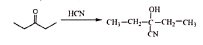
In which case chiral carbon is not generated by reaction with HCN?
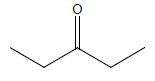
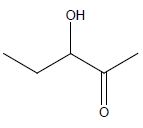
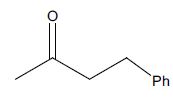
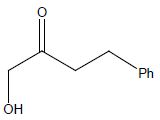
17.
Which one of the following reduces tollens reagent
formic acid
acetic acid
benzophenone
none of these
18.
Benzoic acid \(\overset { i){ NH }_{ 3 } }{ \underset { ii)\Delta }{ \longrightarrow } } A\overset { NaOBr }{ \longrightarrow } B\overset { NaN{ O }_{ 2 }/HCl }{ \longrightarrow } \) C 'C' is ______.
anilinium chloride
O – nitro aniline
benzene diazonium chloride
m– nitro benzoic acid
19.
\({ CH }_{ 2 }={ CH }_{ 2 }\overset { i){ O }_{ 3 } }{ \underset { zn/{ H }_{ 2 }O }{ \longrightarrow } } X\overset { { NH }_{ 3 } }{ \longrightarrow } Y \ 'Y'\) is _______.
Formaldelyde
di acetone ammonia
hexamethylene tetraamine
oxime
20.
21.
Isoprophylbenzene on air oxidation in the presence of dilute acid gives ______.
C6H5COOH
C6H5COCH3
C6H5COC6H5
C6H5- OH
22.
Williamson synthesis of preparing dimethyl ether is a / an ______.
SN1 reactions
SN2 reaction
electrophilic addition
electrophilic substitution
23.
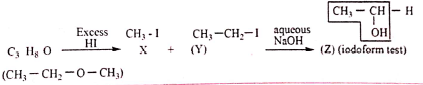
One mole of an organic compound (A) with the formula C3H8O reacts completely with two moles of HI to form X and Y. When Y is boiled with aqueous alkali it forms Z. Z answers the iodoform test. The compound (A) is ______.
propan – 2-ol
propan -1-ol
ethoxy ethane
methoxy ehane
24.
Which of the following compound can be used as antifreeze in automobile rediators?
methanol
ethanol
Neopentyl alcohol
ethan -1, 2-diol
25.
HO CH2 CH2 – OH on heating with periodic acid gives ______.
methanoic acid
Glyoxal
methanol
CO2
26.
In the reaction Ethanol \(\overset { { PCl }_{ 5 } }{ \longrightarrow } X\overset { alc.KOH }{ \longrightarrow } Y\overset { { H }_{ 2 }{ SO }_{ 4 }/{ H }_{ 2 }O }{ \underset { 298k }{ \longrightarrow } } Z.\) The ‘Z’ is ______.
ethane
ethoxyethane
ethylbisulphite
ethanol
27.
The correct IUPAC name of the compound
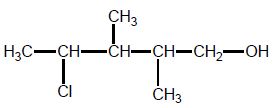
4 – chloro – 2,3 – dimethyl pentan – 1-ol
2,3 – dimethyl – 4- chloropentan -1-ol
2,3,4 – trimethyl – 4- chlorobutan -1-ol
4– chloro – 2,3,4 – trimethyl pentan – 1-ol
28.
Which one of the following will react with phenol to give salicyladehyde after hydrolysis.
Dichlo methane
trichloroethane
trichloro methane
CO2
29.
30.
Which of the following compounds on reaction with methyl magnesium bromide will give tertiary alcohol.
benzaldehyde
propanoic acid
methyl propanoate
acetaldehyde
31.
If x is the amount of adsorb ate and m is the amount of adsorbent, which of the following relations is not related to adsorption process?
x/m = f(P) at constant T
x/m = f(T) at constant P
P = f(T) at constant x/m
x/m = PT
32.
The coagulation values in millimoles per litre of the electrolytes used for the coagulation of As2S3 are given below
(I) (NaCl) = 52
(II) ((BaCl2) = 0.69
(III) (MgSO4) = 0.22
The correct order of their coagulating power is ________.
III > II > I
I > II > III
I > III > II
II > III > I
33.
Collodion is a 4% solution of which one of the following compounds in alcohol – ether mixture?
Nitroglycerine
Cellulose acetate
Glycoldinitrate
Nitrocellulose
34.
Which one of the is not a surfactant?
CH3 -(CH2)15 -N+ -(CH3)2 CH2Br
CH3 -(CH2)15 -NH2
CH3 -(- CH2- )-16CH2 OSO2- Na+
OHC-(CH2)14 -CH2 -COO- Na+
35.
The most effective electrolyte for the coagulation of As2S3Sol is _______.
NaCl
Ba(NO3)2
K3[Fe(CN)6]
Al2(SO4)3
36.
Statement : To stop bleeding from an injury, ferric chloride can be applied. Which comment about the statement is justified?
It is not true, ferric chloride is a poison.
It is true, Fe3+ ions coagulate blood which is a negatively charged sol
It is not true; ferric chloride is ionic and gets into the blood stream.
It is true, coagulation takes place because of formation of negatively charged sol with Cl-.
37.
Which of the following is incorrect for physisorption?
reversible
increases with increase in temperature
low heat of adsorption
increases with increase in surface area
38.
A certain current liberated 0.504gm of hydrogen in 2 hours. How many grams of copper can be liberated by the same current flowing for the same time in a copper sulphate solution ______.
31.75
15.8
7.5
63.5
39.
Conductivity of a saturated solution of a sparingly soluble salt AB (1:1 electrolyte) at 298K is 1.85 ×10⁻⁵ S m−1. Solubility product of the salt AB at 298K (Λom)AB = 14 ×10−3 S m2 mol−1.
5.7 x 10⁻¹²
1.32 x 10⁻¹²
7.5 x 10⁻¹²
1.74 x 10⁻¹²
40.
The equivalent conductance of M/36 solution of a weak monobasic acid is 6 mho cm2 equivalent-1 and at infinite dilution is 400 mho cm2 equivalent-1. The dissociation constant of this acid is ______.
1.25 x 10⁻⁶
6.25 x 10⁻⁶
1.25 x 10⁻⁴
6.25 x 10 -5
41.
Zinc can be coated on iron to produce galvanized iron but the reverse is not possible. It is because _______.
Zinc is lighter than iron
Zinc has lower melting point than iron
Zinc has lower negative electrode potential than iron
Zinc has higher negative electrode potential than iron
42.
During electrolysis of molten sodium chloride, the time required to produce 0.1mole of chlorine gas using a current of 3A is _____.
55 minutes
107.2 minutes
220 minutes
330 minutes
43.
The molar conductivity of a 0.5 mol dm-3 solution of AgNO3 with electrolytic conductivity of 5.76 ×10⁻³ S cm−1at 298 K is______.
2.88 S cm2mol-1
11.52 S cm2mol-1
0.086 S cm2mol-1
28.8 S cm2mol -1
44.
45.
Which of these is not likely to act as Lewis base?
BF3
PF3
CO
F–
46.
Which of the following fluro compounds is most likely to behave as a Lewis base?
BF3
PF3
CF4
SiF4
47.
Conjugate base for Bronsted acids H2O and HF are _______.
OH- and H2FH+, respectively
H3O+ and F-, respectively
OH- and F-, respectively
H3O+ and H2F+, respectively
48.
pH of a saturated solution of Ca(OH)2 is 9. The Solubility product (Ksp) of Ca(OH)2 _______.
0.5 × 10⁻¹⁵
0.25 × 10⁻¹⁰
0.125 × 10⁻¹⁵
0.5 × 10⁻¹⁰
49.
The solubility of BaSO4 in water is 2.42 × 10⁻³gL-1 at 298K. The value of its solubility product(Ksp) will be (Given molar mass of BaSO4 =233g mol-1)
1.08 × 10⁻¹⁴mol2L-2
1.08 × 10⁻¹²mol2L-2
1.08 × 10⁻¹⁰mol2L-2
1.08 × 10⁻⁸mol2L-2
50.
Concentration of the Ag+ ions in a saturated solution of Ag2C2O4 is 2.24 ×10⁻⁴mol L-1 solubility product of Ag2C2O4 is_______.
2.42 × 10⁻⁸mol3L-3
2.66 × 10⁻¹²mol3L-3
4.5 × 10⁻¹¹mol3L-3
5.619 × 10⁻¹²mol3L-3
1.
(b)
PAN
2.
(d)
PHBV
3.
(a)
4.
(c)
Asprin
5.
(d)
6.
(c)
Cytosine and Thiamine
7.
(d)
H3N+-CH(R)-COO-
8.
(a)
Peptide bond
9.
(b)
Sucrose
10.
(c)
D(-) Fructose
11.
(d)
triethylamine
12.
(d)
1,3 – dinitrobenzene
13.
(c)
schiff ’s base
14.
(c)
(CH3)3 C NO2
15.
(b)
potassium salt of phthalimide treated with chlorobenzene followed by hydrolysis with aqueous NaOH solution.
16.
17.

18.

19.
X - HCHO
Y - (CH2)6N4
20.
(d)
21.
phenol
22.
(b)
SN2 reaction
23.
24.
(d)
ethan -1, 2-diol
25.
(c)
methanol
26.

27.
(a)
4 – chloro – 2,3 – dimethyl pentan – 1-ol
28.
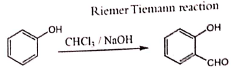
trichloro methane
29.
(c)
30.
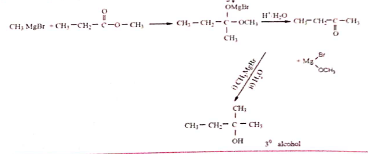
31.
(d)
x/m = PT
32.
coagulating power ∝ 1/coagulation value
33.
Pyroxylin(nitro cellulose)
34.
(b)
CH3 -(CH2)15 -NH2
35.
As2S3 is a negatively charged colloid. It will be most effectively coagulated by the cation with greater valency. i.e., Al3+.
36.
(b)
It is true, Fe3+ ions coagulate blood which is a negatively charged sol
37.
The incorrect statement is option (n)
Physisorption is an exothermic process. Hence increases in temperature decreases the Physisorption
38.
\(\frac{m_{1}}{m_{2}} = \frac{E_{1}}{E_{2}} \)
\(\frac{0.504}{m_{2}} = \frac{1.008}{31.77} \)
m2 = 15.885 g
39.
For 1:1 electrolyte Ksp = S2
\(=[\frac{ K \times 10^{-3}}{Λ^o}]^2\)
\(=[\frac{1.85 \times 10^{-5} \times 10^{-3}}{14 \times 10^{-3}}]^2\)
= (0.1321 x 10⁻³)2
= 0.01745 x 10¹⁰-10
= 1.74 x 10⁻¹²
40.
α = Λ/Λo
= 6/400
Ka = α2C
\(= \frac{6}{400} \times \frac{6}{400} \times \frac{1}{36}\)
= 6.25 x 10⁻⁶
41.
EoZn2+[Zn] = 0.76V and EoFe2+[Fe] = -0.44V
Zinc has higher negative electrode potential than iron, iron cannot be coated on zinc
42.
mass of 1 mole of CI2 gas = 71
∴ mass of 0.1 mole of Cl2 gas = 7.1 g mol-1
m = Zlt
t = m/ZI
\(= \frac{7.1}{\frac{71}{2 \times 96500} \times 3}\) (2Cl- ➝ Cl2 + 2e-)
\(= \frac{2 \times 96500 \times 7.1}{71 \times 3}\)
= 6433.33s = 107.2 min
43.
Λ = k/W x 10−3 mol−1 dm3
\(=\frac{ 5.76 \times 10^{−3} S cm^{−1} \times 10^{−3}}{0.5} = mol^{-1} dm^{3}\)
\(=\frac{ 5.76 \times 10^{−3} S cm^{−1} \times 10^{−3}}{0.5}\) S cm-1 mol−1 dm3
= 11.52 S cm2mol-1
44.
(c)
45.
BF3 → electron deficient → Lewis acid
PF3 → electron rich → Lewis base
CO → having lone pair of electron → Lewis base
F → unshared pair of electron → Lewis base
46.
BF3 → electron deficient → Lewis acid
PF3 → electron rich → Lewis base
CF4 → neutral → neither Lewis acid nor base
SiF4 → neutral → neither Lewis acid nor base
47.
H2O + H2O ⇌ H3O+ + OH-
acid 1 base 1 acid 2 base 2
HF + H2O ⇌ H3O+ + F-
acid 1 base 1 acid 2 base 2
∴ Conjugate bases are OH- and F- respectively.
48.
Ca(OH)2 ⇌ Ca2+ + 2OH-
Given that pH = 9
pOH = 14 - 9 = 5
[pOH = - log10 [OH]]
[OH-] = 10 [pOH]
[OH] = 10-5 M
Ksp = [Ca2+] [OH-]
= 10-5/2 x (10-5)2 = 0.5 x 10⁻¹⁵
49.
BaSO4 ⇌ Ba2+ + SO42-
Ksp = (s) (s)
Ksp = (s)2
= (2.42 × 10⁻³gL-1)2
\(=\frac{2.42 \times 10^{-3} gL^{-1}}{233 \text{ g mol}^{-1}}\)
= (0.01038 x 10⁻³)2
= (1.038 x x 10-5)2
= 1.077 x 10-10
= 1.08 × 10⁻¹⁰mol2L-2
50.
\(\mathrm{Ag}_{2} \mathrm{C_2O_4} \rightleftharpoons 2 \mathrm{Ag}_{}^{+}+\mathrm{C_2O}_{4{}}^{2-}\)
\(\left[\mathrm{Ag}^{+}\right]=2 .24 \) ×10-4mol L-1
\(\mathrm{C_2O}_{4{}}^{2-} = \frac {2.24 \times 10 ^{-4}}{2}\) mol L-1
= 1.12 ×10⁻⁴mol L-1
Ksp = [Ag]2 [C2O42-]
= (2.24 ×10⁻⁴mol L-1) (1.12 ×10⁻⁴mol L-1)
= 5.619 × 10⁻¹²mol3L-3

12th Standard Syllabus & Materials
12th Standard
TN 12th Computer Applications களப்பெயர் முறைமை (DNS) Sample Question Papers Study Material - QB365 Set A
NEW12th Standard
TN 12th Computer Applications வலையமைப்பு எடுத்துக்காட்டுகள் மற்றும் நெறிமுறைகள் Sample Question Papers Study Material - QB365 Set A
NEW12th Standard
TN 12th Computer Applications கணினி வலையமைப்பு ஓர் அறிமுகம் Sample Question Papers Study Material - QB365 Set A
NEW12th Standard
TN 12th Computer Applications PHP-உடன் MySQL-ஐ இணைத்தல் Sample Question Papers Study Material - QB365 Set A



Tamilnadu Stateboard 12th Standard Subjects

Maths
Chemistry

Physics

Biology

Computer Science

Business Maths and Statistics

Economics

Commerce

Accountancy

History

Computer Applications
Biology
Computer Technology
Computer Applications
Computer Science
Business Maths and Statistics
Commerce
Economics
Maths
Chemistry
Physics
Computer Technology
History
Accountancy

Tamil

English

French
Tamilnadu Stateboard Standards


